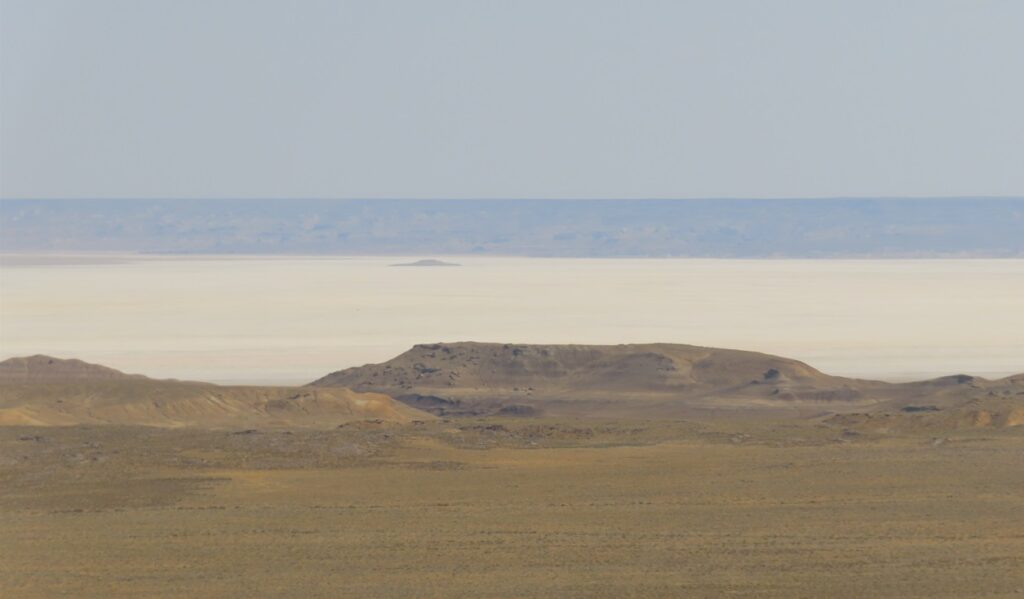
Interpretation of the logger’s graph (using LogTag Analyzer 3 software)
First day and night (July 10-11th)
I installed the measuring equipment in the depression in the late morning during clear and generally calm conditions. The logger was started at 10:46 AM and showed 33.4 degrees Celsius as the first reading. The maximum temperature was reached at 4:57 PM when climbed to 38.8 degrees, with an earlier 38.7 registered at 3:37 PM.
Regarding the general trend the curve can be considered normal, but on the smaller scale the fluctuations are quite noticeable (often 1-1.5 degrees in 2 minutes). This was most likely caused by wind which carried the hotter air from the surface of the nearby steeper slopes, which was actually planned in advance (as mentioned in part 1) to give a little topographical boost to the heating potential.
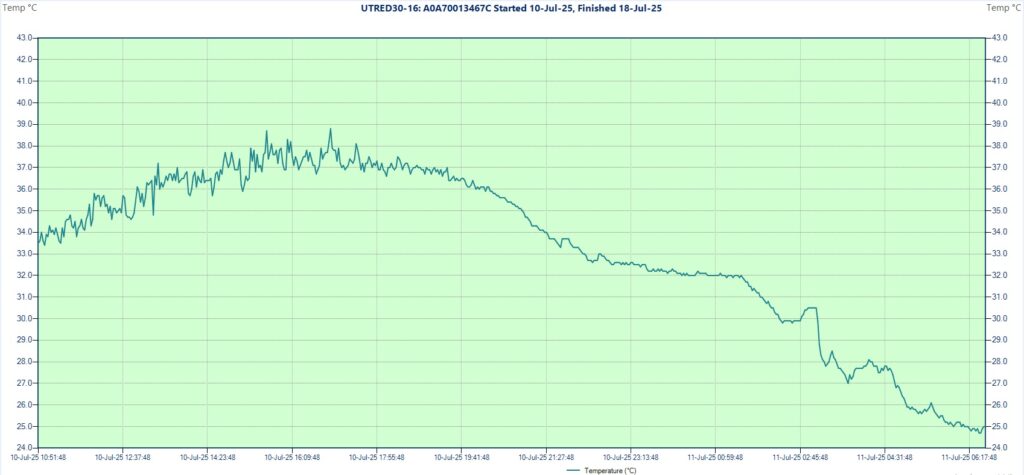
The intensity of the short interval fluctuations dropped significantly in the evening and after 8:15 PM the general descent became somewhat steeper (less wind). Still the temperature remained above 32 degrees until 1:30 AM, then dropping in steps down to 24.7 degrees around 6:30 AM. This will remain the lowest temperature of the entire research. No clouds at all until now.
Second day and night (July 11-12th)
I returned to Beyneu already in the late morning and spent the day in the settlement. During the early afternoon hours some clouds appeared on the sky (mild convection) but generally remained sunny. The curve of the graph presents the same pattern, normal on the big scale with many small seiches.
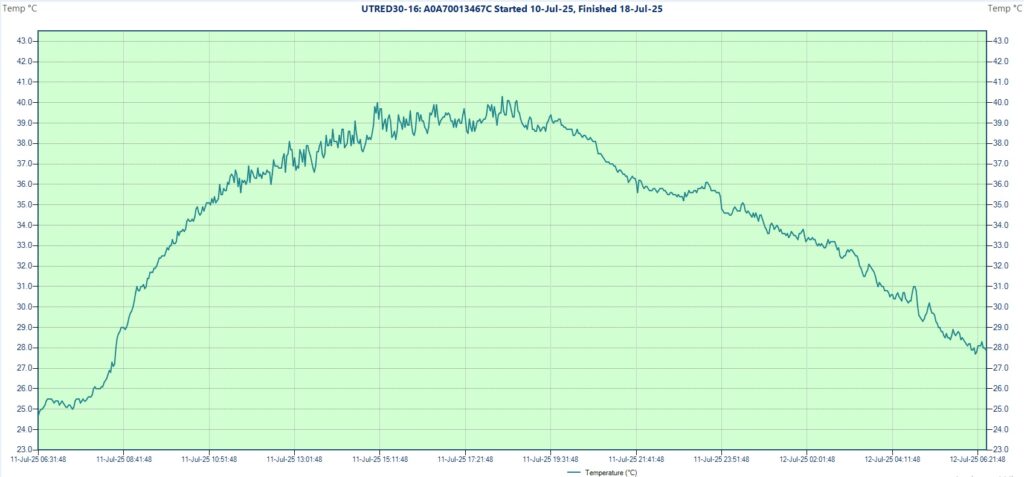
It was hotter than yesterday, the 40 degree mark was first touched at 3:07 PM, than peaked with 40.3 degrees at 6:17 PM. Slightly windy night with a warmer 27.7 degrees minimum recorded at 6:17 AM.
Third day and night (July 12-13th)
In the morning hours I visited Old Beyneu cemetery complex where the sky was clear. After 11 AM convective clouds started to develop in the east, thus the afternoon became partly cloudy. Still the temperature raised following the classic trend, reaching 40 degrees already around 12:30 PM. At 3:07 PM passed above 42 degrees, setting the daily max with 42.4 degrees Celsius at 4:11 PM. This will remain the highest temperature of the entire research.
I personally measured 40-41 degrees in Beyneu’s center in the shade of the “tripod monument” during the afternoon using the Greisinger digital precision thermometer.
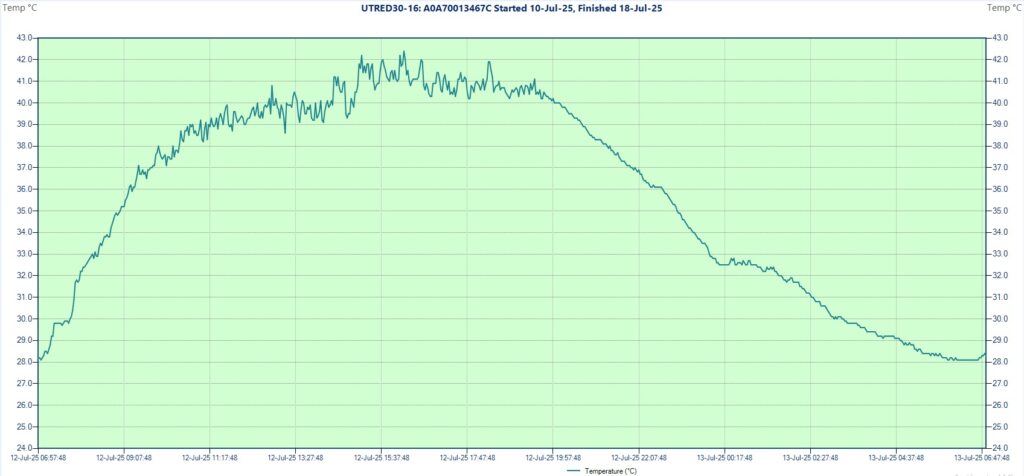
The sharper and smoother drop started after 7:43 PM from 40.5 degrees, dropping to 32.5 shortly after midnight. With small fluctuations, the minimum of 28.1 degrees was reached at 6:11 AM and this value was maintained for full 30 minutes.
Fourth day and night (July 13-14th)
I returned to the installation during the morning observing clear conditions again. In the distance some less developed convective clouds appeared around 11 AM, but the full sunshine lasted until 1-1:30 PM. The maximum of the day was 41.3 degrees and was reached at 3:29 PM, while the sky became partly cloudy. Towards the evening I observed more developed convection in the east (cumulonimbus calvus).
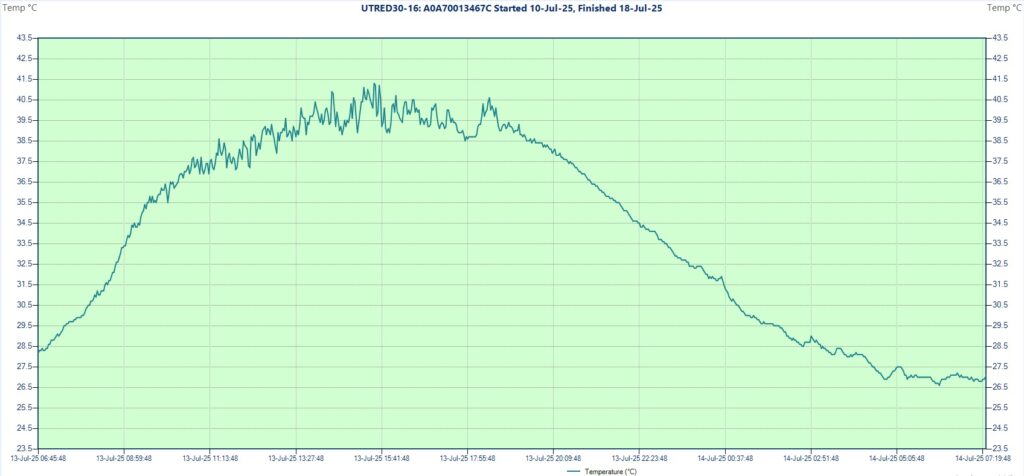
As expected, the night was warm again. The more constant drop started at 7:15 PM from 39.3 degrees and reached 26.6 degrees at 6:11 AM with only slight disturbances in the second part of the night. The sky was more clear than cloudy during the dark hours.
Fifth day and night (July 14-15th)
I returned to Sarga, then Beyneu in the morning, first under a more cloudy then sunnier sky. Still hot, but somewhat less extreme with a normal temperature curve, reaching 39.0 degrees as daily max at 3:23 PM, showing the characteristic seiches related to the uneven heating as usual. The evident drop started a little earlier, around 7 PM this time.
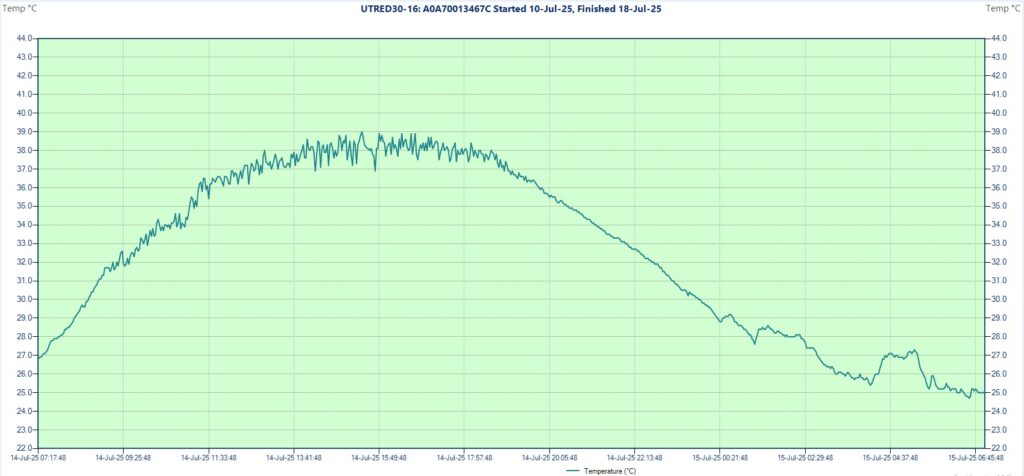
The second part of the night was more unstable than the first when the descent looks clean. In the morning at 6:37 AM the minimum of 24.7 degrees Celsius was reached, equalizing the former lowest temp set in the first night.
Sixth day and night (July 15-16th)
I spent this day in Beyneu observing generally sunny weather with some higher clouds (cirrus) in the morning. This was the mildest day, but still passed well above the human body temperature, reaching 38.2 degrees Celsius shortly after 6 PM, showing some less characteristic bigger scale fluctuations in the first part of the afternoon, likely linked to convection.
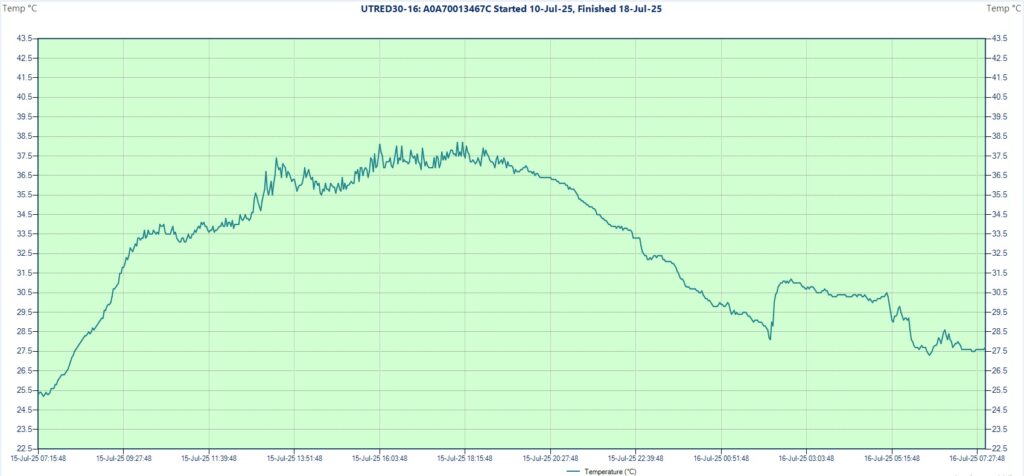
Before 8 PM the typical drop started but was abruptly stopped after 2 AM when it climbed back from 28 degrees to 31 degrees in less than 30 minutes. Maybe wind intensification, maybe passing of a cumulonimbus. Towards the morning it dropped back again, reaching the minimum of 27.3 degrees at 6:13 AM.
Seventh day and night (July 16-17th)
Still in Beyneu, where the morning was cloudy, while later the weather became more sunny and hotter than yesterday. Except the seiches the curve looks quite normal, reaching first time the 40 degree mark at 2:21 PM and setting the daily max of 41.4 degrees in the latter part of the afternoon at 6:17 PM.
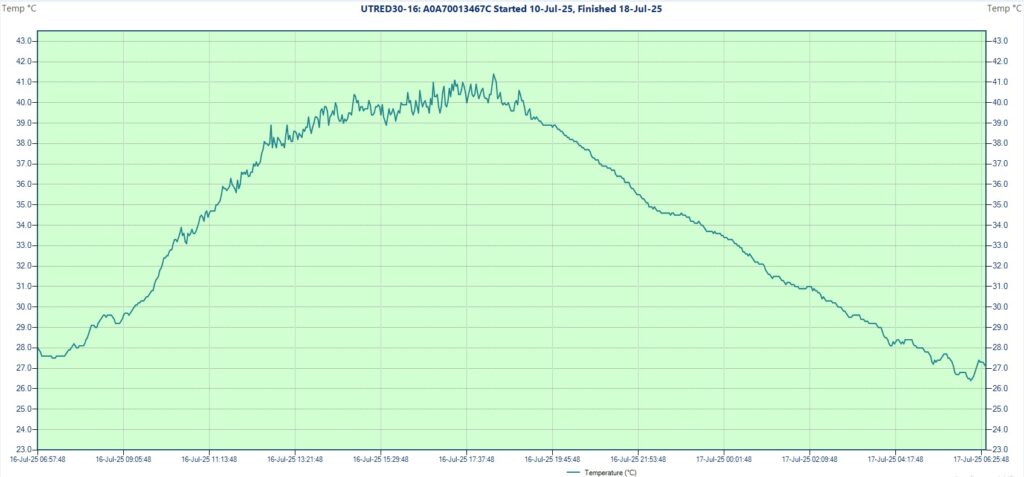
I measured around 40 degrees in Beyneu’s center in the shade using the digital precision thermometer. The diagram shows a pretty clean descent starting around 7:20 PM and this remains generally valid for the entire night. The temp dropped to a 26.4 degree low at 6:09 AM, which can be considered average.
Eighth day and night (July 17-18th)
This was the day of the last field-trip. The morning was generally sunny with some altocumulus lenticularis clouds in the beginning. When I reached the equipment, shortly after 10 AM it was already 36 degrees and around noon managed to touch the 40 degree mark, the earliest between all the researched days.
After 1 PM clouds started to arrive, first only thinner cirrus, but a little later also more compact convective ones, stopping the ascent gradient. Still, the temperature remained surprisingly elevated (40-41 degrees) and stable under the seemingly quite thick blanket, which except a few isolated disruptions managed to entirely cover the sky during the mid-afternoon hours. Thus, when a short sun-window appeared later on, it managed to rise to 42.1 degrees Celsius at 5:25 PM, setting the second highest maximum of the research, which was also the highest one I personally experienced.
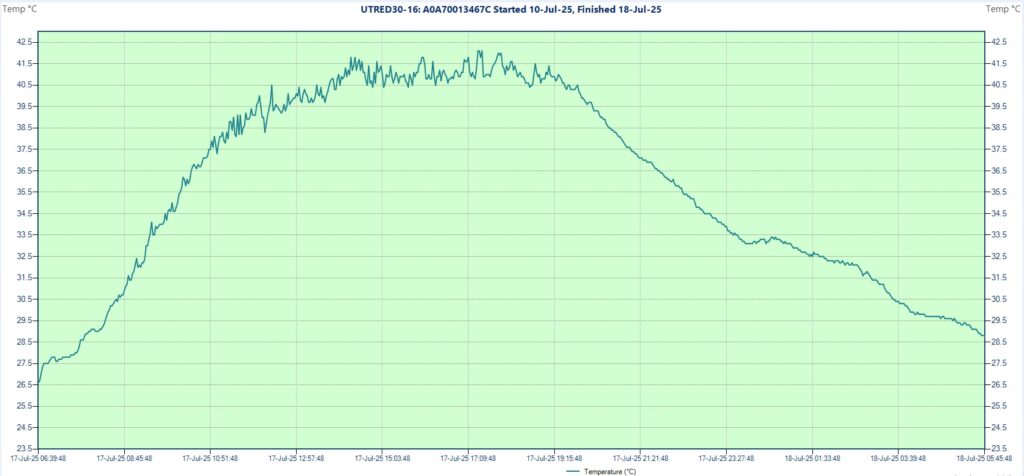
This was the warmest night and while the drop looks relatively undisturbed, at 7 PM it was still above 41 degrees and over 33 degrees past midnight. Around 8 PM there were a few isolated rain drops (passing cumulonimbus) followed by rainbow. I stopped the device at 5:47 AM when the screen showed 28.7 degrees Celsius, likely very close to the hypothetical morning minimum.
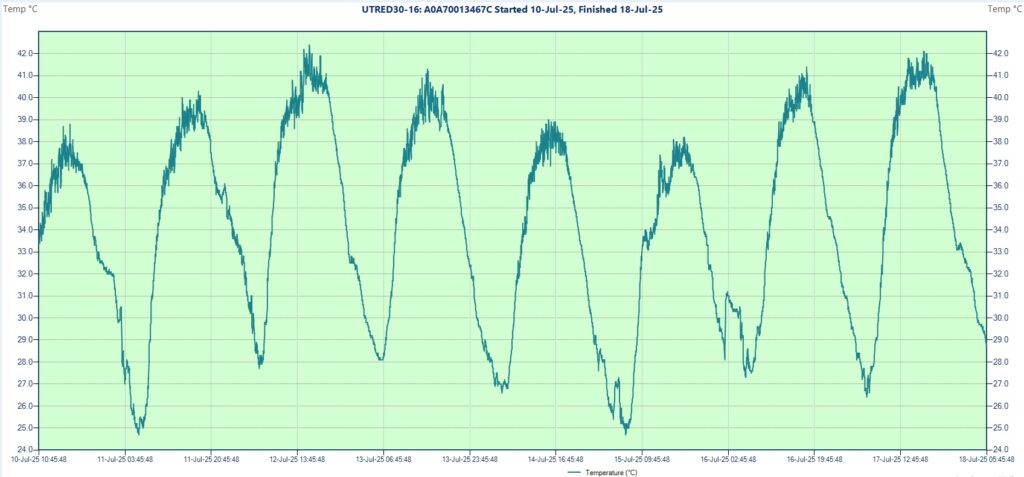
The mean temperature of the 8 day research period was 34.2 degrees Celsius, the average maximum 40.4 degrees, while the average minimum 26.8 degrees Celsius. The mean daily amplitude is 14.2 degrees, fluctuating between 12.4 and 15.6 degrees, which can be considered modest for continental desert climate. On five out of eight cases the temp climbed over 40 degrees and twice above 42 degrees, while the minimum only twice dropped below 25 degrees and twice stayed above 28 degrees Celsius.
General conclusions
- The sky is variable, typically more clear in the morning, while daytime warming often favorizes the formation of convective clouds, more or less
- The wind is generally weak to moderate, usually intensifying during the afternoon hours
- Both the average maximums and minimums are very high in comparison with the latitude, thus reflected in an unusually high mean summer temperature. This is caused by both its low elevation (below sea level) and relatively high latitude (shorter nights during summer). The first insulates the ground via a thicker atmosphere, functioning as a blanket even without clouds, while the latter shortens the time frame of the nocturnal radiation, when the heat-loss can manifest
- Even when cloudy, the temperature remains elevated with surprisingly small real differences between full sunshine and overcast (homogenization factor)
- The general trend of the temperature curve is quite normal, although the maximums sometimes are reached with a little shift towards the latter part of the afternoon around or after 6 PM due to “sunshine windows” after the previous convection period. The evening cooling starts late and is slow, often tempered by wind
- During the day there are many small, sharp rises and drops in the temperature (seiches), giving the characteristic saw aspect to the graph. The typically 1-1.5 degree small scale fluctuations are likely caused by the wind mixing the air of differently heated nearby surfaces
- Rain is rare but can happen, usually very scarce and highly localized under more developed convective clouds (cumulonimbus)
- The air is very dry, this combined with the heat causes that the sweat often evaporates instantly, especially when it’s windier
- Visibility is generally decent, but not exceptionally good because the presence of light suspensions, sometimes dust devils are forming
Comparing my logger’s results with the official data of the local weather stations and other hot locations situated in the temperate climate zone
After finishing the research I tried to get in contact with Beyneu’s official weather station to obtain the necessary data for a professional comparison. Having no success in the settlement, I planned to solve the issue in Aktau at the regional center. Wrongly assuming that it must be at the airport, I missed the target again, being also unlucky with the weekend period.
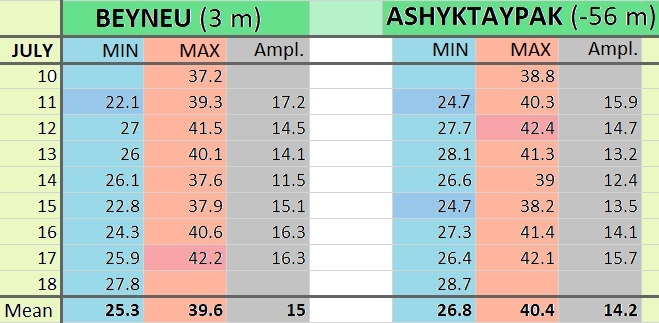
After this failure, at home I was glad to realize that Ogimet could access the summer data of the village’s meteorological station, so here we are. My assumptions regarding the possible slight advantage of the chosen location in the depression seem to have been well-founded: the mean difference between the maximum temperatures during the 8 day research period is +0.8 degrees in favor of Ashyktaypak. Except the last day, when Beyneu surprisingly won by a touch, the endorheic basin was always hotter, sometimes with more than 1.5 degrees.
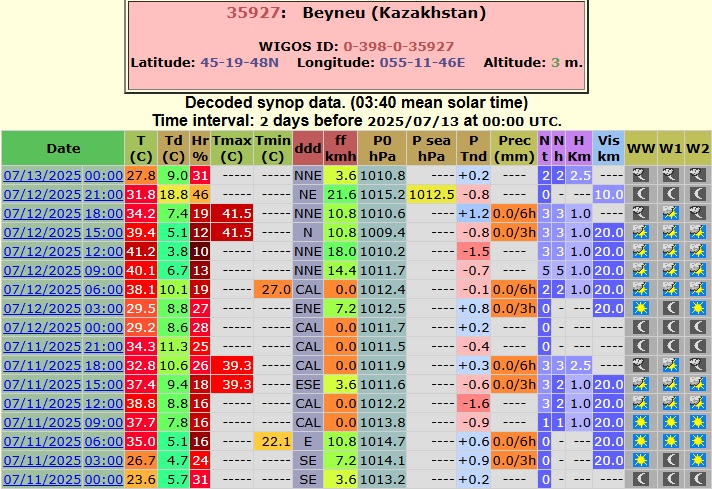
But even that exception is easily explainable: it was the day when during the mid-afternoon hours the sky was completely overcast in the basin, recording the max in the short sun-window around 5:30 PM. It’s highly likely that Beyneu received more sunshine during the hottest interval (3-5 PM) and recorded its 42.2 degrees earlier, when the sky above the basin (situated 20 km farther) was overcast.
If we calculate the difference without this exception the result is exactly +1 degree, which translates into around half degree because of the elevation and the other half because of the topographic enhancement (U-shaped semi-enclosure with more reflected radiation).
Still, the discrepancy was even bigger between the minimum temperatures, Ashyktaypak being 1.5 degrees warmer on average. This is also not a surprise, as the settlement’s station is certainly located in a more open terrain, providing additional space and potential for the nocturnal radiation.
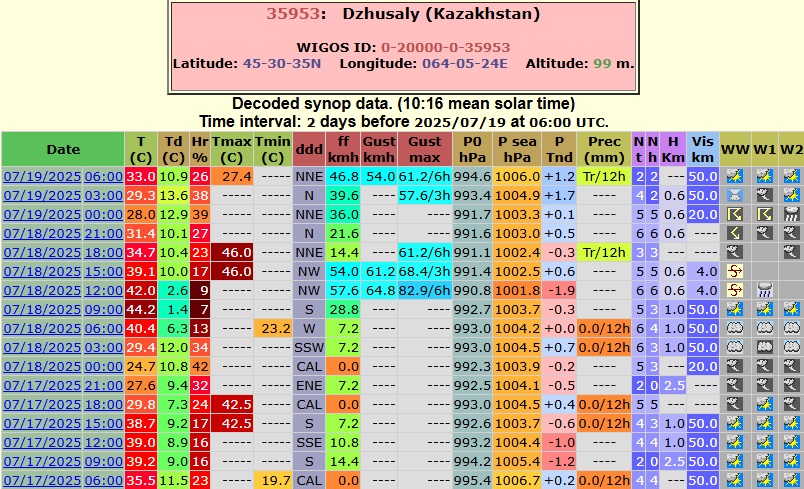
There were a few official stations in Kazakhstan where between 10-17th July the maximum temperature exceeded Beyneu’s 42.2 degrees. According to Ogimet the highest value was 43.7 degrees on 17th recorded in Kaukey settlement, east of the former Aral Sea, which interestingly it’s also situated slightly above the 45 degree latitude. Even Aktau on the Caspian coast went up to 41 degrees on 13th July. While not in the Beyneu area, right in the following afternoon when my research was over, the temperature climbed to 46 degrees in Dzhusaly (not too far from Baikonur), which is also situated a little above 45 N latitude.
Fun fact: In my own country, Romania, in the very day when I was returning home (27th July), the temperatures in the south were close to break the all-time record, rising to 43.4 degrees in Calafat, which is also usually our pole of heat. Situated slightly below 44 degree latitude is even not too far from entering the competition on what my actual research was based on.
Is the Ashyktaypak Depression the hottest place situated closer to the North Pole than to the Equator?
On average, it’s highly likely. That 1 full degree advantage over Beyneu could be decisive regarding any possible competition in other areas too. The closest contenders may be the surroundings of the dried-up Aral Sea, respectively the lower course of the Syr Darya river and the Ebinur Basin (Aibi Hu) in Dzungaria (Western China), all likely approaching or even reaching around 35 degree average July max temperatures.
Honorable mention to the Turpan Depression (-154 meters below the sea level), which while south of the 45 degree latitude (42-43 N) still has a quite northerly setting compared with the extremely hot summers (between 40-42 degree July maxes and extremes up to 50 (!) centigrade), which are well above the ones found in the Beyneu area.
Regarding Lytton (British Columbia/ Canada) or Steele (North Dakota/ USA), locations in North America where the absolute maximum is higher (both exceeded 49 degrees Celsius) than in Beyneu (46.6 degree Celsius), the average summer potential remains significantly lower. The records are very impressive without any doubt, exactly because those kind of extreme events are very rare and need more specific weather pattern synchronization, while their actual 27-30 degree July average maximums would be just average Eastern European values for low elevations around 45-47 degree latitude.